
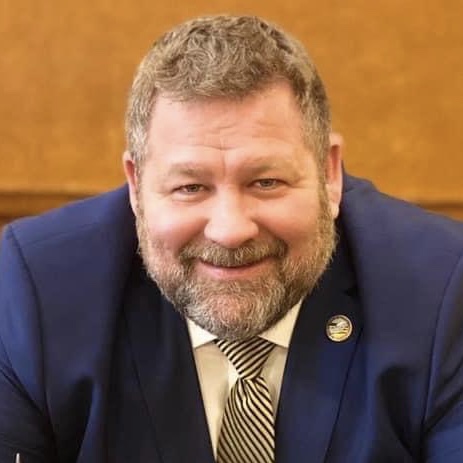
Austin Goss of Dakota News Now reports today that, according to his sources, House Minority Leader Jamie Smith will seek the Democratic nomination for governor.
Smith’s announcement, which is apparently coming this week, will make him the second Democrat to declare his candidacy, following the filing last week of political unknown Barry Hulse of Vermillion. It remains to be seen if Hulse will continue with his gubernatorial bid once Smith launches his candidacy.
Smith, a Realtor in Sioux Falls, is in his third term in the State House, and his second term as House Minority Leader. He represents District 15, traditionally a Democratic stronghold in central Sioux Falls.
As Minority Leader, Smith will follow in a long line of Democratic party floor leaders who have run for governor. Two of them won: Ralph Herseth, who was senate minority leader in 1955 and was elected governor in 1958 (he also ran and lost in 1956, 1960, and 1962); and Richard F. Kneip, who was senate minority leader 1969-70 and then was elected governor in 1970, 1972, and 1974.
Other Democratic leaders who have been their party’s gubernatorial nominee include Lars Herseth (1986), Bernie Hunhoff (1998), Scott Heidepriem (2010), and Billie Sutton (2018). Two others, Elvern Varilek (1982) and Jim Hutmacher (2002), sought the Democratic nomination but lost in the primary.
Assuming Smith wins the Democratic nomination, his likely general election opponent is Governor Kristi Noem, who will be a heavy favorite as a well-funded incumbent in a Republican state. Noem faces a primary challenge from Republican Steve Haugaard, a legislator and former house speaker. History is on Noem’s side: in state history, no elected governor seeking a second term has ever been defeated in a primary election, and Republicans have held the Governor’s Office since 1979.
The last time an elected incumbent lost reelection was 1970, when Governor Frank Farrar, the Republican incumbent, lost reelection to Kneip. Kneip is also the most recent Democrat to be elected governor; he followed his win in 1970 with reelection wins in 1972 and 1974. Harvey Wollman, who served as Kneip’s lieutenant governor from 1975-78, is the most recent Democratic governor; he succeeded to the office when Kneip resigned to become U.S. Ambassador to Singapore, but fell short in his bid for a new term.
South Dakota’s political environment has changed since the 1970s, though. In 1978, Democratic registration was 45.9% to 45.6% for Republicans and 8.5% for others. As of 2020, Republicans have 48.1%, Democrats have 27.5%, and others are 24.4%.
Jamie Smith and Steve Haugaard, though, each face an even more daunting historical precedent. Although recent lieutenant governors have been known to wear facial hair, Smith and Haugaard both seek to become the state’s first mustachioed chief executive since Warren E. Green, who served from 1931-33.
 SoDak Governors