

The late afternoon of Saturday, July 13, 2024 brought a shock to the United States and the world, as former President Donald Trump was grazed by an assassin’s bullet. Trump, who will accept the Republican nomination this week, narrowly missed being struck in the head, as the bullet drew blood from his right ear.
The attempted assassination of Trump is the first to strike a president, or former president, since Ronald Reagan was shot on March 31, 1981. It’s a moment that will certainly take on a “where were you” quality, like 9/11, the assassination of John F. Kennedy, or the moon landing. Because it happened in this modern era of cable news and social media, Americans were able to see the Trump rally and the aftermath of the assassination attempt in real time.
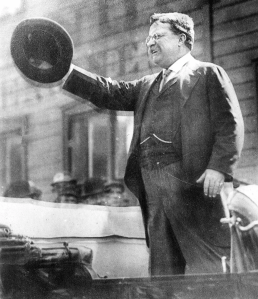
It’s a situation most comparable to the assassination attempt on Theodore Roosevelt on October 14, 1912. Roosevelt, like Trump, was a former president seeking a return to the White House. In Roosevelt’s case, he had failed to secure the Republican nomination, so ran as a Progressive or “Bull Moose” candidate against President William Howard Taft, the Republican incumbent, and New Jersey Governor Woodrow Wilson. Also like Trump, Roosevelt was shot as he delivered a speech. Roosevelt was speaking in Milwaukee (coincidentally the site of this week’s Republican National Convention) and, like Trump, he sought to reassure the crowd, in his case by continuing to speak for more than an hour before seeking medical attention.
Roosevelt had been shot by John Schrank, who believed the late President McKinley had appeared to him in a vision, and was found to be legally insane. The attempted assassination proved Roosevelt’s toughness and brought him goodwill, but it was not enough to overcome the split in the Republican Party, which led to an easy victory for Woodrow Wilson.
Roosevelt and Trump are the only former presidents to be struck by an assassin’s bullet; both survived and were able to continue to pursue their White House comeback bids.
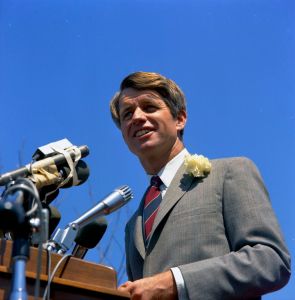
The only active presidential candidate to be assassinated is U.S. Senator Robert F. Kennedy in 1968. RFK was shot by Sirhan Sirhan in the kitchen of the Ambassador Hotel in Los Angeles, shortly after Kennedy had addressed a victory party on the night of the California Democratic Primary. (Kennedy had also prevailed in the South Dakota Democratic Primary that night; the last person he spoke to on the telephone before his death was Bill Dougherty, his SD campaign manager and a future lieutenant governor.)
The RFK assassination continued a tumultuous year in American history. It had begun with President Johnson ended his bid for a second full term, just days before the assassination of Martin Luther King, Jr. Kennedy was killed just two months later, and the 1968 Democratic National Convention, which like this year was held in Chicago, was the site of violent protests. Kennedy’s delegates supported a stand-in candidacy by U.S. Senator George McGovern of South Dakota, which the nomination ultimately went to Vice President Hubert Humphrey of Minnesota, another native South Dakotan.
Another presidential candidate, Governor George C. Wallace of Alabama, was the victim of an assassination attempt in 1972. Wallace, who had run for president as the third-party American Independent candidate in 1968, was running for the Democratic nomination in 1972. Wallace was shot four times by Arthur Bremer in Laurel, Maryland; the shooting left him paralyzed from the waste down for the rest of his life.
Four U.S. Presidents have been assassinated:
- Abraham Lincoln, who was assassinated in April 1865 by John Wilkes Booth at Ford’s Theatre in Washington, just days after the Confederacy’s surrender at Appomattox Court House. It was just a few weeks into Lincoln’s second term, robbing the nation of Lincoln’s wisdom and steady hand during the difficult period of Reconstruction that followed.
- James A. Garfield, who was shot by disappointed office-seeker Charles Guiteau at the Sixth Street Rail Station in July 1881, just four months into Garfield’s term. Garfield died of his injuries two months later.
- William McKinley, who was assassinated by anarchist Leon Czolgosz while McKinley was attending the Pan-American Exposition in Buffalo, New York, in September 1901.
- John F. Kennedy, who was assassinated while riding in an open car through Dealey Plaza in Dallas, Texas by Lee Harvey Oswald, who fired at Kennedy from the sixth floor of the Texas Book Depository.
In addition, there have been numerous assassination attempts against sitting U.S. Presidents. Notable among these are:
- Andrew Jackson, who survived a January 1835 attack when the assassin’s pistols both misfired;
- Harry S. Truman, who was staying at the Blair House while the White House was being renovated, when two Puerto Rican independence activists attacked, killing a policeman who was guarding the house.
- Gerald R. Ford, who was the victim of two assassination attempts just days apart in September 1975, both in California, and both involving female assassins.
- Ronald Reagan, who as was mentioned was shot in March 1981 outside the Washington Hilton by John Hinckley, who was found not guilty by reason of insanity after it emerged that he attempted to assassinate Reagan in a bizarre bid to impress actress Jodie Foster.
In addition, Franklin D. Roosevelt was the victim of an assassination attempt in February 1933, when he was president-elect. Roosevelt was giving a speech in Miami; the assassin missed Roosevelt but shot and killed Chicago Mayor Anton Cermak, who was with Roosevelt.
 SoDak Governors