
Joseph R. Biden Jr., the 46th President of the United States, announced this morning that he will not be a candidate for a second term as President. The announcement was made in a letter posted on social media. President Biden, who is at his home in Delaware recovering from Covid, said that he will address the nation later this week.
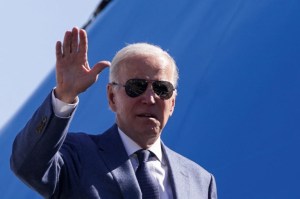
Biden, who was the presumptive Democratic nominee, had been under increasing pressure to end his candidacy following a disastrous debate performance on June 27. That pressure campaign, said to be led by former House Speaker Nancy Pelosi, was successful after 24 days.
Biden will be the fourth U.S. President to serve just one term and not seek reelection. The others are James K. Polk (1845-49), James Buchanan (1857-61) and Rutherford B. Hayes (1877-81).
A more comparable situation, though, may be that of Lyndon B. Johnson. He succeeded to the presidency following the assassination of John F. Kennedy in November 1963 and was reelected in 1964. LBJ sought a second full term in 1968, but ended his candidacy after an embarrassing finish in the New Hampshire primary led Robert F. Kennedy to enter the field. The underlying issue was the Vietnam War. Ultimately, RFK was assassinated, the Democrats nominated Vice President Hubert H. Humphrey, and the election was won by Republican Richard Nixon.
Biden’s withdrawal was not entirely voluntary but, in the end, it was his decision, and it is unprecedented in that he withdrew after he had clinched the nomination. LBJ dropped out early in the nominating process; Polk, Buchanan and Hayes had all pledged when first elected not too see a second term. Biden is the first presumptive nominee in U.S. history to end his candidacy. This will be the first time since Humphrey in 1968 that a party’s presidential nominee did not any presidential primaries.
Biden is the oldest person to serve as President. He will leave office on January 20, 2025 aged 82 years and two months. If former President Donald Trump is elected this fall and completes a four year term, he would eclipse that record by about five months. Biden’s withdrawal also means that Trump, who is 78, is the oldest presidential nominee in U.S. history.
In a second post about half an hour later, Biden endorsed Vice President Kamala Harris for the Democratic nomination for president; he presumably seeks to clear the field for Harris, who has announced that she will seek the nomination. Bill and Hillary Clinton immediately endorsed Harris, and they have been joined by many prominent Democrats, including California Gov. Gavin Newsom, U.S. Senator Elizabeth Warren of Arizona, Former Secretary of State John Kerry, and Congressman Jim Clymer of South Carolina. So have several prospective Harris running mates, including U.S. Senator Mark Kelly of Arizona, Pennsylvania Gov. Josh Shapiro, and North Carolina Gov. Roy Cooper, as well as all fifty state Democratic chairs.
Notably, though, Barack Obama’s statement made no endorsement and hinted at an open nomination process: “I have extraordinary confidence that the leaders of our party will be able to create a process from which an outstanding nominee emerges.” Pelosi is also said to favor an open process, and the New York Times editorial board echoed that call this afternoon. How that plays out will be seen in the coming days. (It was 100 years ago, in 1924, that Democrats took 103 ballots to select a presidential nominee before settling on Ambassador John W. Davis of West Virginia as a compromise. One cast assume that the Democrats hope to avoid a similar process this year.) Note: As of July 23, Harris has apparently won sufficient delegate pledges to secure the Democratic nomination.
Kamala Harris would be the first woman and the first Asian-American to be President, and the second African-American, following Barack Obama. The only other woman to be nominated by a major party for President was Hillary Clinton in 2016. Harris is already the first female Vice President and the third woman to be nominated for Vice President, following Geraldine Ferraro in 1984 and Sarah Palin in 2008. Her husband, Doug Emhoff, would be our country’s first “First Gentleman” and the first Jewish-American to be first spouse.
Harris would also be the first Democratic nominee for President to be a resident of the western half of the country. To date, the westernmost Democratic nominees have been William Jennings Bryan of Nebraska (1896, 1900, 1908), Lyndon B. Johnson of Texas (1964) and George McGovern of South Dakota (1972). Incredibly, Harris set this same milestone in 2020 when she was nominated for Vice President.
Biden’s withdrawal means that the United States will be electing a new president, rather than reelecting an incumbent, for the third straight election: Trump in 2016, Biden in 2020, and either Trump or the new Democratic nominee in 2024. That last happened in the late 1800s, in four straight elections from 1884-1896: Grover Cleveland 1884, Benjamin Harrison 1888, Cleveland returning in 1892, and William McKinley 1896. McKinley ended that streak when he was reelected in 1900.
This period of instability follows the two-term presidencies of Bill Clinton, George W. Bush, and Barack Obama. That was the first streak of three consecutive two-term presidencies since Jefferson-Madison-Monroe from 1801-25.
Former President Trump reacted to Biden’s withdrawal with an on-brand statement, which began: “Crooked Joe Biden was not fit to run for President, and is certainly not fit to serve – And never was!”
Biden’s withdrawal is the latest event in what has become a historic and unpredictable 2024 presidential campaign. Trump seeks to be the first former president to retake the White House since Grover Cleveland, and he narrowly survived an assassination attempt last week. Now Biden makes history with his late departure from the race, potentially positioning Harris to be the first female U.S. President.
I spoke about much of this on this week’s Dakota Town Hall podcast; you can listen to that here.
 SoDak Governors