
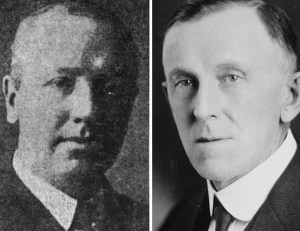
Dan Gehlsen of The Dakota Scout does a great job featuring South Dakota history in the pages of Sioux Falls’ only locally-owned newspaper. This week, Gehlsen writes about the death of Andrew S. Anderson, who was the 1924 Democratic nominee for Governor when he was killed, 100 years ago this week:
A ranching accident 100 years ago this week in southeast South Dakota changed the course of state politics.
Democratic gubernatorial candidate and three—time state Sen. Andrew S. Anderson fell victim to a goring death by a bull while tending cattle on his Union County farm on Aug. 11, 1924, according to The Deadwood Telegram.
Gehlsen also notes that Anderson’s death launched the political career of William J. Bulow, who was named by Democrats as the replacement gubernatorial nominee. Bulow lost in 1924, but was elected Governor in 1926 and 1928, and to the U.S. Senate in 1930 and 1936.
I edited Bulow’s unpublished memoirs, excerpts of which were featured by South Dakota History in 2021. Bulow dedicated his memoirs to Anderson’s bull:
If I make the dedication to the person, or object, or thing, really responsible for my writing, that I should dedicate the book to Andrew S. Anderson’s roan bull. That roan bull was responsible for everything that has happened to me during the last score years of my “three score and ten.”
Andrew S. Anderson was the Democratic nominee for governor. A few weeks before election he walked out into the pasture. The pasture was the domain filled by the bull. The bull would not stand for any intrusion on his domain and hocked, and bunted, and trampled Mr. Anderson to death. This created a vacancy of the ticket and the Democratic State Central Committee filled that vacancy by having my name printed on the ticket.
Had that bull not created that vacancy I never would have run for governor. If I had not run, I never would have been elected. Had I not been elected governor I never would have run for, nor been elected to the senate. Had I never been elected to the senate the Democrats would never have had a chance to put me out of a job in 1942 and fixed it so that I would have nothing to do but write a book. That roan bull was to blame for the whole thing; yet, it was no premeditated aforethought on the part of the bull. He acted on the spur of the moment. He did not intend the consequences of his act. He apparently did not know what he was doing.
 SoDak Governors