
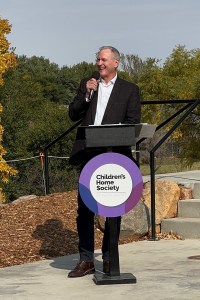
Dennis Daugaard served as Governor of South Dakota from 2011-19. Before that time, he spent 24 years in various roles with Children’s Home Society of South Dakota.
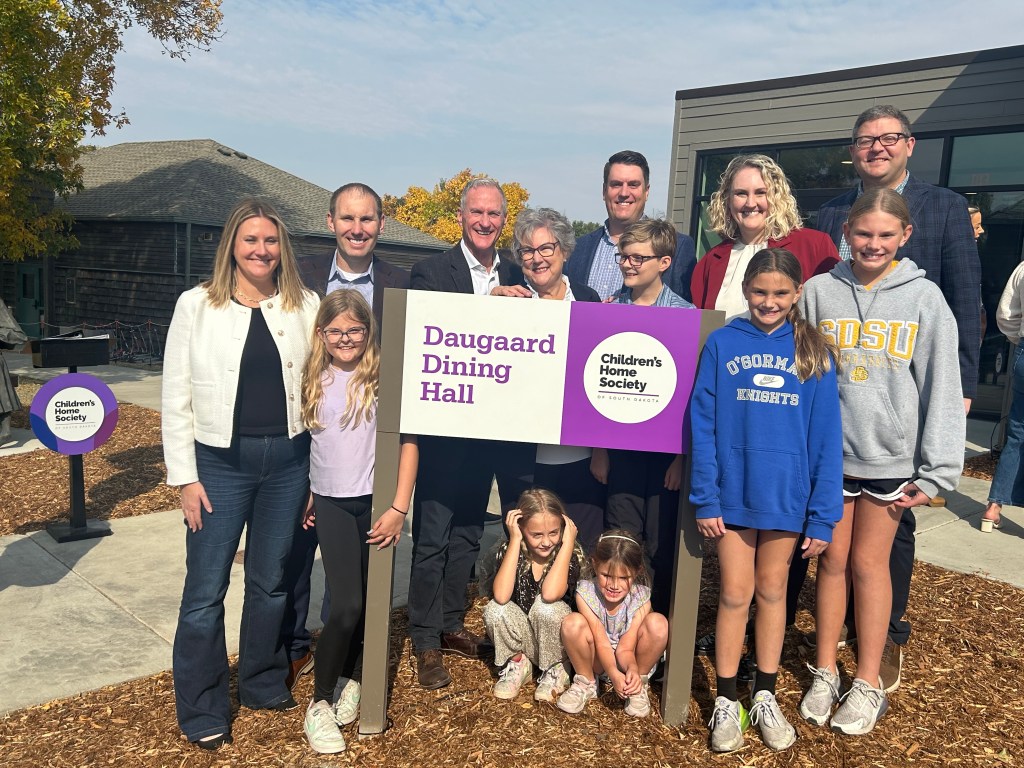
Today, Children’s Home Society honored Daugaard with the opening of the Daugaard Dining Hall, a new facility at the society’s Sioux Falls campus that serves the children who live there, and the campus’s staff. The new dining hall is double the size of the facility it replaces.
For the past several years, I have been working with Nathan Sanderson and other former Daugaard staffers to write about Governor Daugaard’s life and administration. Below I have compiled a few excerpts, highlighting his work for Children’s Home Society:
In 1985, one of Dennis’ co-workers accepted a job at an Arizona bank, and asked Dennis if he would take his place in a volunteer role at Children’s Home Society of South Dakota. Although he knew little about the organization, Dennis agreed, and was soon elected to the board of directors. His first meeting as a board member was also the first meeting of Children’s Home’s new executive director, David Loving. It was an eye-opening experience for Dennis:
Until my association with Children’s Home Society, I was largely unaffected by child abuse and neglect. These were things that happened in big cities, not South Dakota, I thought. The stories of children in residence at Sioux Falls Children’s Home or Black Hills Children’s Home disabused me of that notion. Over the next few years, my quarterly board meetings and monthly committee meetings heightened my interest in Children’s Home Society, and my belief in their mission.
In the late 1980s, Dennis became the president of the Children’s Home board of directors and developed a closer working relationship with David Loving. After a committee meeting in 1989, Loving asked Dennis if he knew anyone who could lead the Children’s Home Foundation, the separate non-profit fundraising arm of Children’s Home that had been without a leader for several years. When Dennis couldn’t think of anyone, Loving asked him to consider it himself.
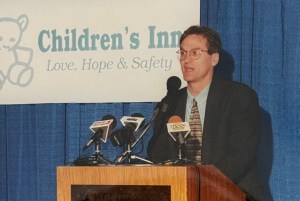
Dennis interviewed for the job and was offered it, but turned it down. He soon regretted his decision, but another person had been hired. Fortunately, that person left only a year later. Given a second chance, Dennis resigned from the bank and became executive director of the Children’s Home Foundation in December 1990.
The Sioux Falls Chamber of Commerce had just endorsed Children’s Home for a 1991 capital fundraising campaign, to aid in the construction of a gym, dining hall, and maintenance building at Sioux Falls Children’s Home. Not knowing the basics of charitable fundraising, Dennis had much to learn. Relying on a hired consultant as a mentor, he surpassed the campaign’s fundraising goals.
It was the first of what would be many capital campaigns over the succeeding years, through which Children’s Home built a new school, gymnasium, and maintenance building at Black Hills Children’s Home, another residential building at Sioux Falls Children’s Home, an emergency shelter in Rapid City, a foster home in Sioux Falls, and forensic exam facilities at both ends of the state. After merging with Children’s Inn, a Sioux Falls shelter for victims of domestic violence, still another fundraising campaign enabled the shelter to expand. For all these projects, no debt was incurred; construction began only after the money was raised.
In 1994, Dennis traveled regularly to the Black Hills, raising funds for Black Hills Children’s Home and building contacts. Even as he traveled, he tried to involved his family, as his daughter Sara would recall:
More often than not, when Dad traveled for Children’s Home, he would take one of us kids along. It was a great treat for us, as we got to skip school (but not the homework), spend a lot of time with Dad, and stay with different people. Usually these trips were several days to a week in length. We never stayed in hotel rooms, instead staying in the spare bedrooms of donors or board members of Children’s Home to save expenses.
One summer, when I was a fourth grader, Black Hills Children’s Home undertook a major development campaign to raise money for a brand-new school building. It was going to require Dad to be out in Rapid City most of the time, so our whole family decided to pick up and move to the Hills for the summer. Of course, to save on expenses, we actually stayed onsite at BHCH in an older office building. A couple of us kids slept on a pull-out couch in a reception area and two offices were converted into bedrooms.
We thought it was a grand adventure. We often ate lunch in the cafeteria with the kids, we played with them on the playground, and even learned how to rollerblade. We also got to spend all summer in one of the best places in America to vacation, and we took many trips to Mt. Rushmore, Crazy Horse, and one of my personal favorites, the Cosmos.
A major fundraising event for Children’s Home grew out of Linda’s traditional family Christmas. Every year, the Schmidt family would rent the St. Mary’s Catholic School lunchroom on Christmas Eve – no home could accommodate Linda’s parents, eleven brothers and sisters, and their spouses and children.
Linda’s sister, Margaret, was married to Mark Amundson, an avid golfer who worked as a physical therapist for the Senior PGA Tour. At the Schmidt Christmas in 1995, Dennis and Mark discussed the potential for a charity golf event, attended by Senior PGA golfers after their August tour event in Minneapolis. Working with prominent Australian golfer Graham Marsh, Mark secured commitments from senior pros to attend the August event. Dennis recruited Orion Food Systems as the title sponsor of the “Orion Classic.” Sioux Falls banker T. Denny Sanford agreed to loan his jet to transport the golfers from Minneapolis to Sioux Falls, and then on to their next tour event.
The Orion Classic was a success and grew into one of Sioux Falls’ largest annual charity events, continuing to evolve but remaining a charity banquet and golf tournament. By 2023, the event had raised more than $9.2 million for Children’s Home.
By the late 1990s, Dennis had built the Children’s Home Foundation into one of South Dakota’s most successful charities. With the Foundation’s support, capacity at Children’s Home Society, at all locations, had more than doubled. The society’s debts had been paid and facilities were significantly expanded and improved. Nevertheless, Dennis was concerned that Children’s Home was highly dependent upon Medicaid revenue, and vulnerable to changes in that single government source. With that in mind, the Children’s Home Society and Foundation boards of directors adopted a long-range goal to build an endowment that, with a 5% annual distribution, would cover 25% of Children’s Home’s annual expenses. With $8 million in annual expenses at the time, this required an endowment of $40 million.
As a first step toward this long-term goal, Dennis sought a multi-million-dollar challenge gift, to encourage matching gifts from others. After months of effort, Dennis had raised $1.5 million in challenge gifts from anonymous donors, but he had found no donor willing to be the “face” of the public challenge.
That changed when Dennis and board member Linda Mickelson met T. Denny Sanford for lunch and asked that he make a public $1 million challenge to support the campaign. Sanford agreed to consider it. A month later, he let Dennis know that he had decided against giving $1 million – and instead would give $2 million. Sanford’s $2 million challenge was announced in April 1999 and, along with the $1.5 million in anonymous gifts, it attracted an additional $3.5 million in matching funds over the next three years.
The $7 million total was the largest in Children’s Home’s history, and it was also significant as Sanford’s first multi-million-dollar donation in South Dakota, in what would become a historic record of philanthropy that would eventually exceed $2 billion.
Sanford exceeded his first challenge in 2005, when Dennis asked him to offer $14 million as a further endowment challenge, donating $3 for every $1 contributed by others. That goal was reached in three years. In ten years, thanks to Sanford’s aggressive challenge grants, Dennis had led fundraising of more than $25 million for the Children’s Home endowment.
The year 2001 brought changes at Children’s Home, as David Loving informed the board of directors that he planned to retire in 2003. He recommended that Dennis be his successor as executive director. A committee of the board was appointed to interview Dennis and, following that interview, Dennis was offered the job. As a transition, Dennis was named Children’s Home Society’s chief operating officer in 2002. Dennis also agreed not to seek reelection as a state senator in 2002, for what would have been his fourth and final term.
Dennis was elected lieutenant governor on a ticket with Mike Rounds in 2002, but his role was part-time and he continued to lead Children’s Home Society until he resigned in October 2009 to focus on his campaign for governor. He and Linda have continued to be active volunteers and supporters, with Linda later serving on the board of the Children’s Home Foundation.
 SoDak Governors