

Books about South Dakota governors are few and far between. My book, The Governors of South Dakota, is a general overview. I have also compiled a list of books about specific governors on this page. These range from traditional biographies, to autobiographies, to book-length articles, to even one comic book.
Greg Redlin’s Janklow, though, is something new in the field: a work of historical fiction.
Redlin, who worked for Janklow in the budget office in the late 1970s and early 1980s, focuses his book on Janklow’s rise to power: how he came from nowhere, with no money and no connections, and reached the peak of political power in South Dakota.
At one point in Janklow, two characters discuss Robert Penn Warren’s classic 1946 novel All the King’s Men, and that work clearly inspired Redlin (it’s also one of my favorite novels). All the King’s Men is based on the rise to power and ultimate corruption of Huey Long, who was Governor of Louisiana and a U.S. Senator in the 1920s and 1930s. It is a roman à clef, though, meaning that it tells the story in broad strokes and changes all the names – Huey Long becomes “Willie Stark” – and it is not clear if the supporting characters are based on real people. That is likewise true of the 1996 novel Primary Colors, famously written by “Anonymous” and later revealed to be the work of Newsweek reporter Joe Klein. That book, based on Bill Clinton’s 1992 presidential candidacy, renames the Clintons as “Jack and Susan Stanton.” Janklow, though not as nationally prominent as Long or Clinton, is a complex and compelling figure deserving of the same treatment.
Redlin’s book is not a pure roman à clef, though, because many of the names have not been changed. Bill Janklow remains Bill Janklow, and other major characters who have passed on appear as themselves, including Joe Barnett, Mark Meierhenry, and Jim Abdnor. They are intermingled with fictional composite characters, based on other Janklow staffers. The story is told through the eyes of narrator “Jake Keating,” a young new staffer who, according to Redlin, isn’t based on a specific person. The Keating character is reminiscent of All the King’s Men‘s Jack Burden and Primary Colors‘ Henry Burton (who was reportedly based on George Stephanopoulos). Keating’s girlfriend, Anne, is another fictional character, taking her name from the love interest in All the King’s Men.

Janklow adheres to history more closely than a roman à clef, and it therefore reminded me of another book, Edmund Morris’ 1999 Dutch: A Memoirs of Ronald Reagan. Morris, who was the acclaimed author of The Rise of Theodore Roosevelt, had been selected by President Reagan to write his official biography. He made the unorthodox decision, though, to write himself – Morris – into Reagan’s life and to make himself the narrator. This meant that Morris, who was born in 1940 and raised in Kenya and South Africa, recalled Reagan’s work as a Dixon, Illinois lifeguard in the 1920s as if he had been there. Dutch was controversial when it was released, but it is an enjoyable read and the unusual narrative device offers insights into Reagan that a traditional biography may not.
The mixture in Janklow of real characters with fictionalized composites can be distracting – more than once I found myself trying to ascertain “who was who.” There are also a few instances of a character being described but never named; longtime Janklow friend Jeremiah D. Murphy is an obvious example.
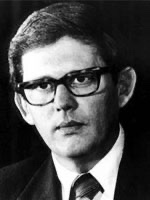
The first three-quarters of the book deal with Janklow’s early career – his rise to attorney general, his first eight years as governor, and his loss in the 1986 U.S. Senate primary. Many familiar stories are retold, including “greatest hits” like saving the railroads, attracting Citibank, and closing the state university in Springfield.
A primary thread through the story is Janklow’s relationships with the state’s tribes: his early years as a legal aid attorney on Rosebud, his time as a prosecutor of American Indian Movement activists like Dennis Banks and Russell Means, and his continued pursuit of Banks during his time in office. A visit to Korczak Ziolkowski at Crazy Horse is an amusing story. The longstanding, and long debunked, rape allegations against Janklow from his Rosebud days are also addressed, with Janklow deeply affected by the allegations and even threatening in more than one case to leave politics entirely.
Redlin worked for Janklow during the early years, and Janklow’s second eight-years is covered in just a single chapter. There is only a brief mention property tax relief, and none of the wiring the schools initiative, the Spencer tornado, the death of Gina Score, or the triumphant dedication of the World War II Memorial in the days after 9/11. This is in part due to Redlin’s focus on Janklow’s “rise to power,” but it also reflects that he was not personally involved with this part of Janklow’s career.
That focus on the first administration also means that, regrettably, none of the strong women who worked for Janklow are portrayed, either by name or as a composite character. Janklow named the first female lieutenant governor (Carole Hillard), the first female Supreme Court justice (Judy Meierhenry), and the first female chief of staff (Dianna Miller), and his second eight years included figures such as Deb Bowman, Pam Roberts, Sandy Zinter, and Doneen Hollingsworth; I would have enjoyed reading about those characters as well.
The closing of the book covers the car-motorcycle accident that ended Janklow’s political career. It ends with Janklow’s brain cancer diagnosis and his efforts at the end of his life to reconnect with friends and reconcile with opponents, including a reunion with Russell Means that brings the story full-circle.
Janklow is an entertaining read. For those who don’t know the Janklow story well, it is a good introduction to his story and to the essence of his character. For those who know the history, or who have spent time with Janklow or with his large cadre of loyal former staffers, many of the stories are familiar, as they have been told and retold for decades. In that way, the use of historical fiction is appropriate; a good story, well-told, often evolves over the years into something more than what it was. Sometimes, a story is too good to check.
“Janklow” is available at Outside a Dog Books & Games in Vermillion, Zandbroz Variety in Sioux Falls, DDR Books in Watertown, or in paperback or Kindle editions on Amazon.
 SoDak Governors