
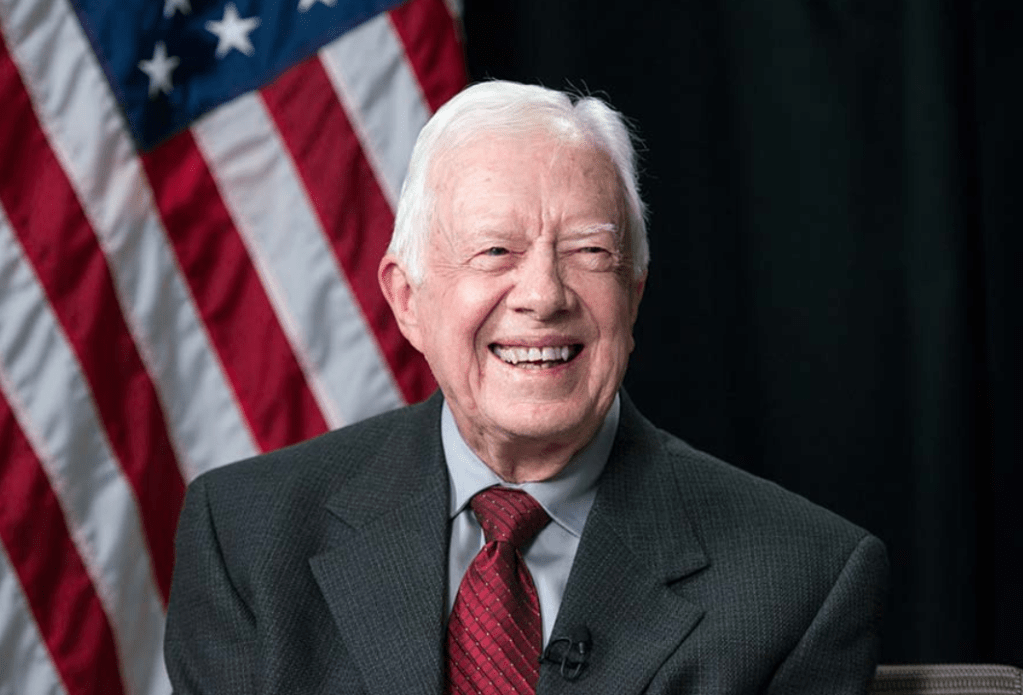
James Earl Carter Jr., the 39th President of the United States, has died. Known always as “Jimmy,” the Georgia governor and peanut farmer was the first native of the Deep South to be elected president since before the Civil War. At age 100, he was the first President to live for a century.
Carter, the darkest of dark horses when he launched his presidential candidacy, benefited from the Watergate backlash and won the Democratic nomination against a strong field of familiar Washington figures. The six presidents prior to Carter were all longtime Washington insiders; Carter began a 32-year period in which every president but one was a Washington outsider.
President Gerald R. Ford had restored a sense of honesty to the Oval Office following Watergate, and Carter continued that. His advocacy for peace netted a major achievement with the Camp David Accords between Israel and Egypt. Carter struggled, though, amidst economic malaise, the OPEC oil embargo, and turmoil around the world. The Iran Hostage Crisis was probably the last straw, and he lost reelection in a 1980 landslide to the former Governor of California, Ronald Reagan.
Carter had won the 1976 Democratic Presidential Primary in South Dakota, but narrowly lost the state’s electoral votes that fall to President Ford. In 1980, former Lt. Governor Bill Dougherty engineered a Democratic Primary victory in South Dakota for U.S. Senator Edward M. Kennedy of Massachusetts in his ultimately unsuccessful challenge to President Carter; Dougherty had also led Robert F. Kennedy’s 1968 candidacy in South Dakota. As in 1976, South Dakota’s electoral votes went Republican.
Perhaps Carter’s most direct impact on South Dakota politics was his appointment, in 1978, of Governor Richard F. Kneip to serve as U.S. Ambassador to Singapore. Kneip and Carter were friends from their years together in the National Governors Association; the appointment of Kneip elevated Lt. Governor Harvey Wollman to the Governor’s Office for five months.
The Carter years coincided not only with the last period of Democratic control in Pierre, but also with the service in the U.S. Senate of George McGovern and James Abourezk. Neither were close to Carter, and both would lose their seats during the Carter years; Abourezk didn’t seek reelection in 1978, facing the looming candidacy of Congressman Larry Pressler, and McGovern lost reelection in 1980 to Congressman Jim Abdnor as Ronald Reagan defeated Carter.
Despite that loss, Carter became a beloved figure, universally recognized for his kindness and decency. It was often said that he’d been “too nice” to be president, but he was among our greatest Former Presidents. Carter eschewed corporate boards and large speaking fees, instead writing books and attracting visitors to his home church in Plains, Georgia for Sunday School. He and his wife, Rosalynn, became the most famous volunteers for Habitat for Humanity; Carter helped build homes on South Dakota’s Cheyenne River Reservation in 1994. Mrs. Carter, who passed away in November 2023, also continued her activism on behalf of mental health. In 2002, Carter won the Nobel Peace Prize for his lifetime activism for peace.
Carter came to have a close relationship with President Ford, after they struck up a friendship traveling together as ex-Presidents to the 1981 funeral of Egyptian President Anwar Sadat. One-time rivals, Ford and Carter will likely both remembered as better people than presidents. Carter delivered a eulogy for Ford following his death in 2006.
Jimmy and Rosalynn Carter lived out their lives in the small home they built in the 1960s; the home has been donated to the National Park Service and will become a National Historic Site now that they both have passed on. That humble home will be a fitting memorial to the man from Plains.
 SoDak Governors