
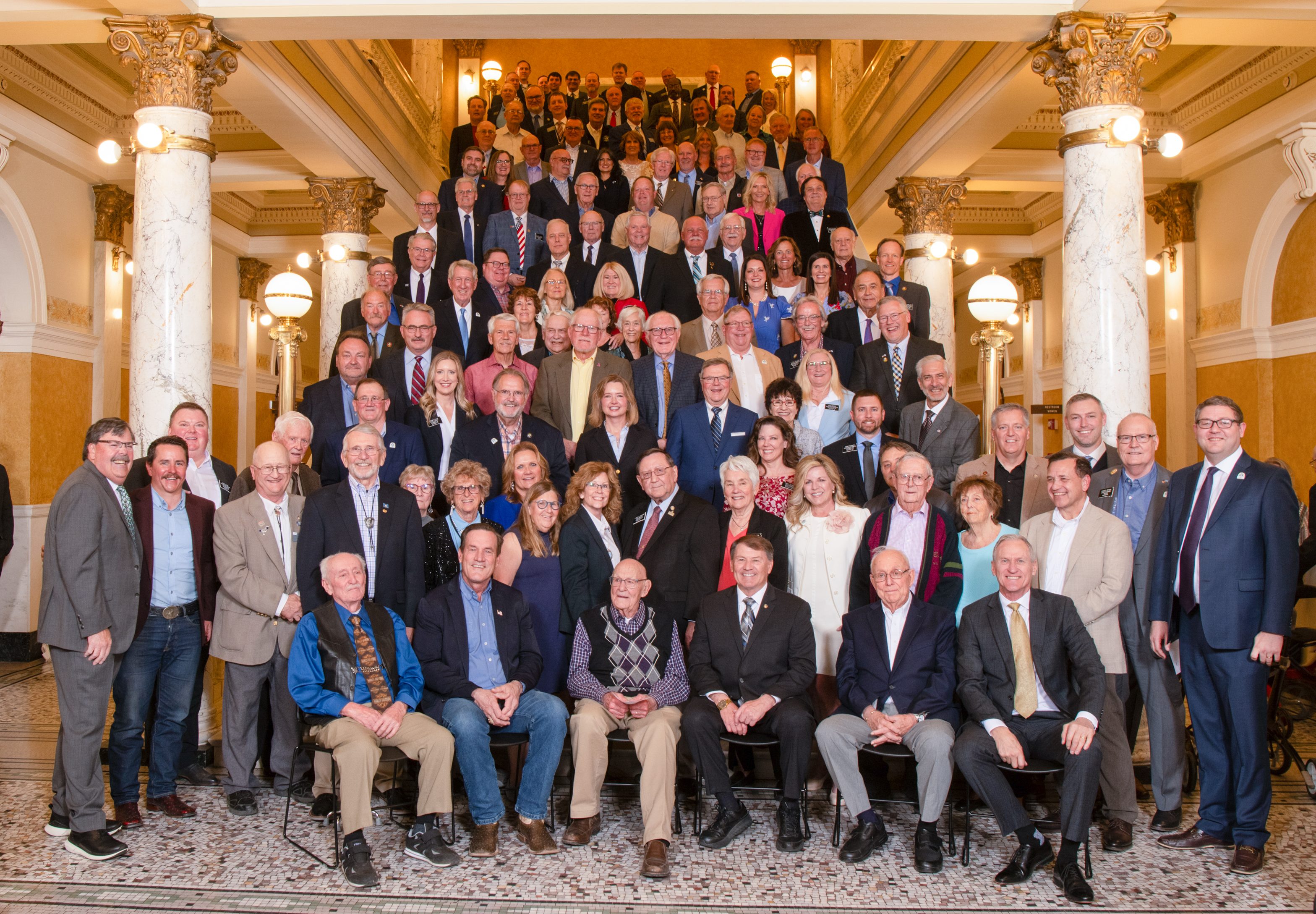
It was this blogger’s honor to chair the planning committee for the commemorations of the 100th Legislative Session. In that capacity, I was invited to deliver an address to the observance that was held on April 12, 2025 at the State Capitol. I have been asked by a few people to share a copy of that address; it is included below.
Address in honor of the 100th Session of the South Dakota State Legislature
Delivered by Lt. Governor Tony Venhuizen, April 12, 2025
Good afternoon.
It’s a great honor to be here today to celebrate the milestone of our 100th Session of the South Dakota State Legislature.
For 100 sessions, South Dakotans have sent their neighbors to Pierre to serve—not as full-time politicians, but as citizen legislators. Teachers, farmers, small business owners, nurses, ranchers, retirees, even the occasional lawyer. Ordinary people entrusted with the extraordinary task of writing our laws.
I want to begin today by thanking the people who helped make this commemoration possible. I had the privilege of chairing the 100th Session Planning Committee, and I want to thank my vice chair, David Wheeler, and the rest of the committee for their insight, energy, and dedication: Jean Hunhoff, Steve Kolbeck, Erin Healy, Steph Sauder, Bernie Hunhoff, Matt Michels, and our State Historian, Dr. Ben Jones.
We had great support from our legislative colleagues, and I particularly want to thank Speaker Jon Hansen, President Pro Tempore Chris Karr, and their predecessors, Lee Schoenbeck and Hugh Bartels.
We were supported every step of the way by our excellent Legislative Research Council staff: especially John McCollough, Rachael Person, Lance Nixon, and Michelle Deyo-Amende. We also appreciated the support of Governor Kristi Noem and Governor Larry Rhoden, State Arts Director Patrick Baker, Special Projects Director Leah Haugan, and many others.
I especially want to thank the South Dakota State Historical Society Foundation, especially Catherine Forsch and Amanda Van Balen, whose partnership has been essential to organizing today’s events.
Today is the culmination of our celebration of the 100th Legislative Session. It was great over the past few months to see how legislators took pride in being a part of this milestone. We have taken several steps to celebrate and preserve this history.
As a part of our work, we improved our online historical director of legislators. We supported the publication of a book highlighting key moments from our state’s legislative history, which is available today at the reception.
We created an artistic display of Bernie Hunhoff’s poem about the citizen legislature, which now hang in the lobbies behind the Senate and the House. We partnered with the State Historical Society to create displays and educational materials. We offered sponsorships so that more students than ever could visit our Capitol during the legislative session, so that they will be inspired to serve during our next 100 sessions.
And, we raised funds from current and former legislators to commission the Termesphere, depicting the dynamic nature of the Senate and House.
It has been a fun project, and we have all enjoyed the opportunity to be a part of it. I want to make sure we don’t lose sight, though, of what we are celebrating – and why.
The South Dakota State Legislature held its first regular session in 1890. It met biennially until 1963 and has met annually ever since. That’s why we are reaching our 100th session in our 136th year of statehood.
For that entire time, this institution has remained what it was at the start: a citizen legislature, deliberately part-time, close to the people, and rooted in the values of republican self-government.
In the first State of the State Address, Governor Mellette said this to the first state legislators:
You have been called to this high honor by your constituents through their confidence in your ability and integrity, and only honesty and intelligence and industry can meet their expectations and the demands of your position.
The legislature has evolved considerably over these 100 sessions. Our first legislators met in borrowed buildings in a frontier cow-town. Today, we serve in a beautiful Capitol built on optimism – but also on thrift. Don’t forget, we saved money on this building by buying the plans, secondhand, from Montana.
Our early legislative sessions were shaped by agrarian values, fiscal restraint, and deep skepticism of government excess. Those themes still echo in our debates today.
The legislature was once overwhelmingly rural and male. But that has changed. Women first entered the legislature in 1923, and today they make up more than a third of our members. In recent years, we’ve seen record numbers of Native American legislators, including in leadership positions. The legislature looks more like the people it serves than ever before.
We used to legislate in paper and ink, with bills distributed by pages and messages spindled on desks. Today, we use iPads and livestreams. The internet has made our work more transparent, more searchable, and more accessible. South Dakotans can follow floor debates and testimony in real time from anywhere in the world—and even testify themselves from their homes.
We used to rely solely on face-to-face conversation, letters, and phone calls. Now, a constituent can email us. Rather than passing a note, or having a quiet side conversation, we may send a text message.
And yet the personal relationships remain just as important. The legislature has always depended on the ability of people from very different places, and very different experiences, to listen, learn, and collaborate.
We’ve seen changes to the size and structure of the legislature—from single-member districts to multi-member ones, from biennial budgets to annual ones. We’ve adopted term limits, restructured our calendar, and embraced new technology. And yet the core remains.
We remain a citizen legislature. Our legislators come here for nine weeks in the winter. They work very hard for a short time. They don’t have individual staff, but rather rely on support from our excellent Legislative Research Council, and from college interns. When our work is done, legislators go home, to their normal lives, jobs, and families.
Our legislature remains a place where committee hearings are open and public, where anyone can testify on any bill, and where every bill receives a final disposition. In South Dakota, you can just walk into the State Capitol, walk up to a legislator, and tell him what you think – without an appointment, without going through any staff.
We should never take that for granted. There is almost nowhere else that is like that. But it is true here.
South Dakota has been well-served by this approach. Like any legislature, we don’t always make everybody happy. Everyone here has been disappointed at one time or another – probably many times. But we do pretty well. And we do it with a fair, open, civil process.
And so, as we commemorate the 100th session, we do so with pride. We look back to honor those who built this institution. We look around to celebrate those who serve in it now. And we look ahead, confident that the next 100 sessions will be just as vibrant, just as open, and just as committed to the people of South Dakota.
As I close today, though, I want to remind us what we are really celebrating.
This program today isn’t about 100 sessions. That’s just a number. It isn’t about this Capitol building, as proud of it as we are. It isn’t even really about those of us who have served in the legislature, although we appreciate that service.
This celebration is about the people who we serve. In South Dakota, our state motto says, “Under God, the People Rule.” Our part-time, citizen legislature is special because it is close to the people. Because it is drawn from the people. They send us here. They watch our work, they participate in our process. And when we go home, they tell us how they think we did.
They count on us to do their work. To listen, to legislate, and to represent them with honesty, intelligence, and industry. It truly is one of the highest callings of a free people in a republic.
As we look ahead to the next 100 sessions, let us do what we can to ensure that we remain worthy of the people who we serve.
Thank you.
 SoDak Governors