
The 2020 election results are in and, as expected, Republicans have maintained control of both the State Senate and the State House of Representatives. An earlier post looked at the history of partisan control of the South Dakota State Legislature. With the results in, the 2021 State Legislature will be the most Republican since 1953, and each chamber individually will also be the most Republican since 1953. (In 1953, Republicans controlled the State Senate 35-0 and the State House 73-2.)
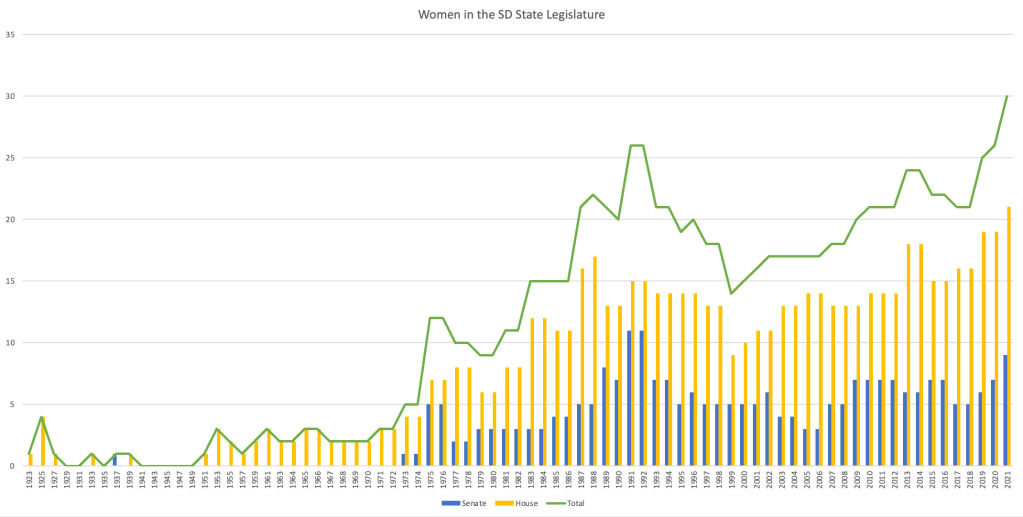
The 2021 Legislature will have 30 women as members, the most in state history. The previous record of 26 women had been set in 1991 and 1992, and was tied last year. Nine of the 30 women will be serving as legislators for the first time.
Twenty-one women will serve in the 70-member House, the most ever. Nine women will serve in the 35-member Senate (only in 1991-92 were there more, when 11 women served). They will include Jean Hunhoff, who was elected to the Senate and will extend her record as the longest-serving female legislator in state history. Twenty-five of the female legislators will be Republican, and five will be Democrats.
At the bottom of this post is a chart showing the number of women serving in previous legislative sessions.
Republicans will control the State Senate 32-3, a gain of two seats from the previous body:
- Challenger Michael Rohl defeated Democratic Sen. Susan Wismer in District 1, in the state’s northeast corner. Wismer had served in the legislature for ten years and was the first woman ever nominated by a major party for governor when she was the Democratic nominee in 2014.
- The aforementioned Jean Hunhoff, currently serving in the State House, will return to the State Senate, winning the seat being vacated by retiring Democratic Sen. Craig Kennedy.
The three returning Democratic senators all represent traditional Democratic strongholds: Reynold Nesiba from District 15, the central Sioux Falls “cathedral district,” Troy Heinert from District 26, which includes the Rosebud Reservation, and Red Dawn Foster from District 27, which includes the Pine Ridge Reservation. All three were reelected in reasonably close contests, winning by 10%, 8%, and 12% respectively.
The State House of Representatives will be controlled by Republicans 62-8. Republicans gained 3 seats from the previous House:
- In District 9, which includes Hartford and Humboldt, Republican newcomer Bethany Soye defeated incumbent Democratic Rep. Michael Saba.
- In District 13, which is in south Sioux Falls, Democratic incumbent Rep. Kelly Sullivan lost to Republican Richard Thomason.
- In District 17, which is Clay and Turner counties, two new Republican candidates, Sydney Davis and Richard Vasgaard, won the two House seats, which had previously been held by term-limited Reps. Nancy Rasmussen (a Republican) and Ray Ring (a Democrat).
With these results, there will be only 11 Democratic in the State Legislature. Nine of them come from traditional Democratic districts: three from District 15 in Sioux Falls (Sen. Nesiba and Reps. Jamie Smith and Linda Duba), and six from districts that include Indian reservations (Sens. Heinert and Foster, and Reps. Jennifer Healy Keintz, Peri Pourier, Shawn Bordeaux, and Oren Lesmeister). There will be only two Democratic legislators serving who are not from one of these strongholds: Rep. Erin Healy from District 14 in southeast Sioux Falls, and Rep. Ryan Cwach from Yankton County.
Six Native Americans will serve in the new legislature, an increase of one. In addition to the four Democrats mentioned above – Sens. Heinert and Foster and Reps. Pourier and Bordeaux – there will be two Republicans who are Native American: Rep. Tamara St. John, who was reelected from District 1, and newcomer Will Mortenson, who was elected to the State House from District 24, which includes Pierre and the surrounding area.
Overall, four incumbent legislators lost reelection on Tuesday, all Democrats: Sen. Wismer in District 1, Rep. Saba in District 9, Rep. Sullivan in District 13, and Rep. Steve McCleerey, the assistant house minority leader, who lost his District 1 seat to fellow Democrat Jennifer Healy Keintz.
The new Senate will include 21 returning members (including Sen. Casey Crabtree, who was appointed after session last year), 8 representatives moving to the Senate, and 6 first-time legislators. The House will include 46 returning members, 3 senators moving to the House, 7 former legislators returning to Pierre, and 14 first-time legislators.
Now that the legislative elections are over, the focus will turn to leadership elections with each party caucus. Republicans are choosing new majority leaders in both houses – Senate Majority Leader Kris Langer did not seek reelection and House Majority Leader Lee Qualm was term-limited. The Democratic leaders, Sen. Troy Heinert and Rep. Jamie Smith, are returning and will likely stay in their leadership roles. In the term limits era (since 2000), the only majority or minority leader to serve for more than four years is Bernie Hunhoff, who was House Minority Leader for six years from 2009-14.
Other leadership roles to be filled include Speaker of the House, Speaker Pro Tem, President Pro Tem of the Senate, and assistant leaders and whips in both houses. Once that is done, new committee assignments will be made.
Women in the State Legislature, by legislative session
 SoDak Governors