

The Republican National Convention opens in Milwaukee tomorrow, on July 15, 2024. What always promised to be a significant political event, as Donald J. Trump secures the Republican nomination for the third straight time, has taken on additional elements of drama, as the convention opens less than forty-eight hours after the former president narrowly survived an assassination attempt in Butler, Pennsylvania.
Trump is the first former president to make a serious comeback bid since Theodore Roosevelt, who after failing to win the Republican nomination ran on the Progressive “Bull Moose” ticket in 1912 against President William Howard Taft, the Republican incumbent, and Democratic Governor Woodrow Wilson of New Jersey. Roosevelt, like Trump, survived an assassination attempt during that presidential bid; they are the only two former presidents to be struck by an assassin’s bullet, and both survived.
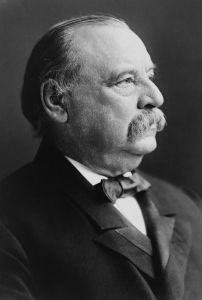
If Trump prevails, he will become only the second U.S. President to serve two non-consecutive terms, following Grover Cleveland. Cleveland, the governor of New York, won the Democratic nomination in 1884 and prevailed against Republican James G. Blaine, a former U.S. Senator, Speaker of the House, and Secretary of State from Maine. In 1888, Cleveland narrowly lost reelection to U.S. Senator Benjamin Harrison of Indiana; Cleveland won the popular vote but lost the electoral vote. (Harrison’s election paved the way for statehood for South Dakota and North Dakota.) In 1892, Cleveland made a successful comeback bid, challenging Harrison again and returning to the White House. Although there was no constitutional two-term limit at that time, Cleveland did not seek a third term in 1896.
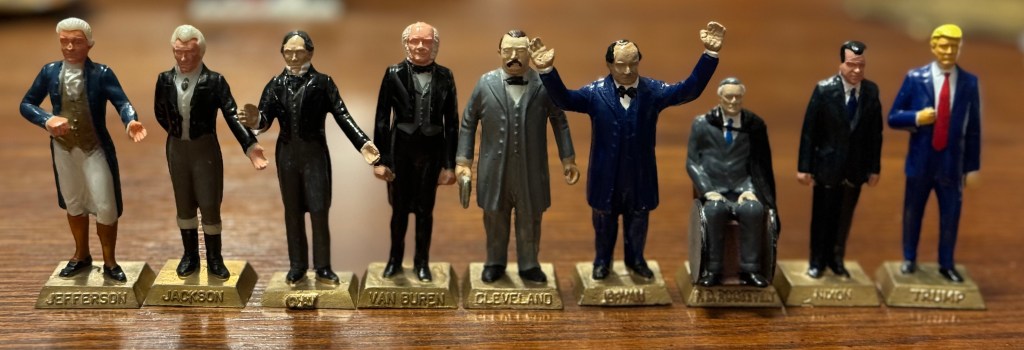
By accepting the nomination this week, Trump also joins a short list of Americans who have three times been a party’s nominee for President. Also on that list are:
- Thomas Jefferson, who was the nominee of what we today call the Democratic-Republican Party in 1796 (losing to John Adams and becoming vice president), 1800 (defeating John Adams and his fellow partisan Aaron Burr), and 1804 (winning reelection against Federalist Charles Cotesworth Pinckney). At this time, presidential nominees were chosen by the parties’ congressional caucuses. In 1796 and 1800, presidential electors voted for two candidates without specifying which was for president and which was for vice president. That led to the bizarre circumstance of Jefferson serving as vice president under his opponent, John Adams, after 1796 and, in 1800, Jefferson finishing in a tie with Aaron Burr, who had widely been understood to be the candidate for vice president. The 12th Amendment to the U.S. Constitution was passed prior to 1804, putting in place the system we still use today.
- Andrew Jackson, who was nominated by several state legislatures for president in 1824. The Federalist Party had died and nomination by congressional caucuses had fallen out of favor, so in 1824 all the major candidates were members of the Democratic-Republican Party, and all were nominated by state legislatures. Jackson ran against John Quincy Adams, Henry Clay, and William Crawford. Jackson won both the popular vote and the electoral college, but no candidate won a majority and the election was settled by the U.S. House of Representatives, which selected Adams. Clay, who had thrown his support to Adams, was thereafter appointed by Adams as Secretary of State. Jackson labeled in “the corrupt bargain,” and the popular anger fueled the founding of the Democratic Party and Jackson’s successful challenge of Adams in 1828, as well as his reelection against Clay in 1832.
- Henry Clay, who as mentioned was a candidate in 1824 and 1832, losing both times to Andrew Jackson. The Whig Party was formed to oppose Jackson and the Democrats, with Clay as its most prominent leader; he served at various times as U.S. Senator, Speaker of the House, and Secretary of State. Clay was a candidate for the presidential nomination every four years; he was nominated for a third and final time in 1844, losing to Democrat James K. Polk.
- Martin Van Buren, who was a Jackson lieutenant and one of the original “political operatives” in the founding of the Democratic Party. Van Buren served Jackson as Secretary of State and as Vice President, and was elected to succeed him in 1836. Four years later, amidst an economic depression, Van Buren lost reelection to General William Henry Harrison, the nominee of the Whig Party. Van Buren sought the Democratic nomination again 1844, losing to James K. Polk. Following that loss, Van Buren’s opposition to slavery alienated him from Polk and the Democrats, and his third nomination came in 1848 from the Free Soil Party, a minor party created to oppose slavery. Van Buren lost, but the Free Soil Party would contribute to the founding in 1854 of the Republican Party, meaning that Van Buren played a role in the founding of both modern American political parties.
- Grover Cleveland, who as mentioned above was elected in 1884, defeated in 1888, and elected again in 1892.
- William Jennings Bryan, who joins Henry Clay as the only three-time losers. Bryan was a populist Democrat from Nebraska. Amidst the economic downturn of the 1890s, the Democratic Party turned away from the East Coast conservatism of Grover Cleveland, and toward the prairie populism of Bryan. He was nominated in 1896 by both the Democratic and Populist parties, losing to Republican William McKinley. Bryan lost a rematch with McKinley in 1900. He was nominated once more in 1908, losing to Republican William Howard Taft.
- Franklin D. Roosevelt, the only American to be nominated for president four times. FDR, the governor of New York, was the Democratic nominee in 1932, defeating incumbent President Herbert Hoover in a landslide amidst the Great Depression. He was reelected in a bigger landslide against Kansas Governor Alfred Landon in 1936. With World War II looming, FDR made the unprecedented decision to seek a third consecutive term in 1940. He was elected again, although by a lesser margin, defeating New York utility executive Wendell Willkie. In 1944, with the United States now engaged in World War II, FDR won a fourth term against New York Governor Thomas E. Dewey. Roosevelt died a few months into his fourth term, in April 1945, just before the allies won the final victory in World War II.
- Richard Nixon, who served in the U.S. House and the U.S. Senate from California before being selected as Dwight D. Eisenhower’s running mate in 1952. Nixon served for eight years as vice president and was the Republican nominee to succeed Eisenhower in 1960, losing narrowly to Democratic U.S. Senator John F. Kennedy amidst allegations of voter fraud. Nixon ran for governor of California in 1962 and lost, but returned to win the Republican nomination in 1968, defeating Democrat Hubert Humphrey in that tumultuous year. Nixon was overwhelmingly reelected in 1972 against U.S. Senator George McGovern of South Dakota, but resigned in August 1974 amidst the Watergate scandal.
 SoDak Governors