
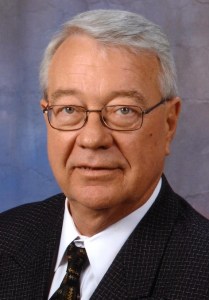
R. Lars Herseth, the 1986 Democratic nominee for governor and a member of one of South Dakota’s most important political families, died on September 12 at his Brown County farm. Herseth, who was 80, served as a legislative leader in both the State Senate and the State House of Representatives.
Herseth was a farmer from Houghton, in rural Brown County, where his family had been involved in agriculture and public life for generations. His father, Ralph E. Herseth, was a farmer and legislator who was elected governor in 1958, becoming South Dakota’s first Democratic governor in 22 years. Governor Herseth served from 1959 to 1961 and narrowly lost reelection to Archie Gubbrud in 1960. Lars’s mother, Lorna Herseth, was First Lady during her husband’s tenure as governor, and continued the family tradition of public service after Ralph’s death, serving as South Dakota secretary of state from 1973 to 1979.
Lars Herseth entered the State House of Representatives in 1975, aged just 28, and quickly became one of the leading Democrats in the legislature, becoming House minority leader in 1979. He served in the House through 1986, when he gave up his seat to run for governor.
The 1986 primary and general election was one of the most interesting in South Dakota’s history. The Democratic primary for governor included Herseth, former Governor Richard F. Kneip, who had served as governor from 1971 to 1978, and Public Utilities Commissioner Kenneth Stofferahn. Kneip began the race as the favorite, but Herseth scored an upset, winning 42.8% to Kneip’s 38.7%; he was aided by persistent attacks from Stofferahn on Kneip. The 4.2-point margin remains one of the closest gubernatorial primary results in South Dakota history.
Republicans had an equally competitive four-way primary for Governor that year. Former House Speaker George S. Mickelson prevailed with 35.3%, narrowly avoiding a runoff and defeating former Congressman Clint Roberts, who received 32.1%. (The other candidates were Lt. Governor Lowell Hansen and Secretary of State Alice Kundert.) Both gubernatorial primaries that year are among the closest in state history.
The Herseth v. Mickelson matchup created another first, as both nominees were the sons of former governors. Mickelson’s father, George T. Mickelson, had served as governor from 1947 to 1951. Like both primaries, the 1986 general election was close. Mickelson and his running mate, Walter Dale Miller, defeated Herseth and running mate Ted Thoms by 51.8% to 48.2%, a margin of only 10,645 votes. It was the closest South Dakota gubernatorial election, by percentage and by vote margin, between 1964 and 2018.
Herseth’s political career did not end with that defeat. He returned to the legislature two years later, winning election to the State Senate in 1988. He served there through 1996 and became one of the Senate’s leading Democrats. When Democrats briefly won control of the Senate in 1993, their only period of Senate control in the last half-century, Herseth served as president pro tempore. He later served as Senate minority leader in 1995-96.
Altogether, Herseth served twenty years in the South Dakota Legislature. Ten years ago, I wrote about Herseth as one of the “Old Bulls of the State Legislature,” recalling him among the long-tenured legislative leaders of the pre-term limits era of the 1970s to 1990s. With Herseth’s passing, 100-year-old Homer Harding is the last living member of that list.
Herseth’s excellent obituary recalls his old-school approach to service in the legislature:
During those years, Lars was known for his legislative acumen, command of the issues, collegiality that knew no partisan bounds, and being true to his word. He was exceptionally fair-minded and a steadfast advocate for women’s rights and Native American issues. During his final legislative term, he spoke passionately in opposition to a bill that sought to prevent recognition of same-sex marriage.
Lars was particularly engaged in issues affecting agriculture, transportation, economic development and health care. His approach to public life was to put solving problems for the people of South Dakota ahead of political differences. Few issues demonstrated that conviction more clearly than South Dakota’s railroad crisis of the late 1970s and early 1980s. As abandonment of rail lines jeopardized the state’s transportation infrastructure and agricultural economy, Lars worked with Governor Bill Janklow and legislators of both parties to preserve essential rail service.
Notably, Herseth was one of two legislators who was invited by Governor Bill Janklow’s family to speak at his State Capitol memorial service in 2012. The other was former House Majority Leader Larry Gabriel, a Republican.
As the Democratic nominee for governor in 1986, Herseth had been the longest-ago South Dakota gubernatorial nominee who was still living. With his death, that distinction passes to Bernie Hunhoff, the Democratic nominee in 1998. Hunhoff is now the only living gubernatorial nominee, from either party, whose candidacy dates to the 20th century.
Herseth’s departure from the state legislature was followed, just six years later, by the candidacy of his daughter, Stephanie, for U.S. House, carrying the family legacy to a third generation. Stephanie Herseth lost the 2002 election to Governor Bill Janklow, but she was elected to Congress in a special election in 2004 following Janklow’s resignation. She served seven years in the U.S. House and, since 2017, has served as president of Augustana University.
The Herseth family occupies a unique place in South Dakota political history. Ralph Herseth was governor and a legislative leader. Lorna Herseth was secretary of state. Lars Herseth spent twenty years in the legislature and came within 10,645 votes of becoming governor. Stephanie Herseth Sandlin served nearly seven years in Congress and today leads one of the state’s major universities. Few South Dakota families can match that record of public service across three generations.
Three years ago, Herseth sat down for a two-hour oral history interview with Dr. Ben Jones, the South Dakota State Historian. The video of that interview is available here. His obituary has been posted here.

