
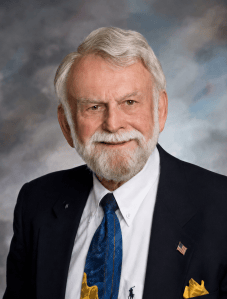
The news comes that Stanford M. Adelstein, 94, passed away on Monday, August 10.
Stan was a fixture in the Rapid City community – as a business, political, civic, and religious leader – for decades. He was president of Northwestern Engineering Company, a supporter of nearly every civic and cultural institution in the Black Hills, and a prominent leader of South Dakota’s small Jewish community.
Stan served for 11 years in the South Dakota State Legislature – in the State House from 2001-04, and in the State Senate from 2005-06 and 2009-13.
My first job in South Dakota politics was on the Mike Rounds gubernatorial campaign in 2002. I was sent to Rapid City to set up the Rounds field office. Our office was in “the gap” on West Main, in a Jackson-Hewitt tax office that was owned by Stan. Rounds was the decided underdog in a Republican primary against Attorney General Mark Barnett and former Lt. Governor Steve Kirby. Barnett and Kirby had considerably more money, while the Rounds campaign was largely a family-and-volunteer operation. I was one of those volunteers.
Stan Adelstein was a crucial financial supporter of the Rounds campaign, directly and through a series of political actions committees that he controlled. As I have written before, Rounds’ victory was one of the great upsets in South Dakota political history. He won 44.3% of the vote, compared to 29.5% for Barnett and 26.1% for Kirby. The Rounds campaign prevailed against two better-funded opponents, but likely could not have without Stan Adelstein’s support.
I continued on the Rounds campaign through the fall, taking a semester off of college. After the November election, Governor-elect Rounds made be an intern on the transition team, knowing that I would not be otherwise occupied until I returned to school in January. The Rounds transition team included Stan Adelstein along with many other interesting figures, such as Don Rounds, Jamie Rounds, Rob Skjonsberg, Randy Frederick, Pam Roberts and Deb Bowman. For a 20-year-old political junkie, it was quite an education.
Stan was entering his second term in the State House at this time. He was a Republican, but not an especially predictable one. He was conservative on many fiscal and business issues, but moderate or liberal on some social issues. More importantly, he was fiercely independent. He had strong opinions about what the Republican Party ought to stand for, and he was willing to spend his own money to advance those opinions. Sometimes quite a bit of it.
Stan became a major financial supporter of legislative candidates he considered “mainstream” Republicans, including candidates challenging fellow Republicans in primaries. He was instrumental in the South Dakota Mainstream Coalition, an organization created in the mid-2000s to push back against the increasingly conservative direction of the Republican Party. The results were mixed, but the consequence was that when Stan returned to the State Senate in 2009, he was serving alongside several Republican colleagues who he had targeted for defeat.
The mid-2000s also brought an unusual series of elections for Stan in his own district. In 2004, he made the move from the State House to the State Senate after defeating pro-life activist Elli Schwiesow in the Republican primary, 51% to 49%. Two years later, Schwiesow defeated Stan in a rematch, 52% to 48%. Following his defeat, Stan endorsed and financially backed the Democratic nominee, Tom Katus, who defeated Schwiesow 53% to 47%.
In 2008, Stan wanted to return to the Senate, challenging Katus, the man he had helped elect in 2006. Schwiesow eschewed a primary rematch and ran as in independent. It was a razor-thin margin, with Stan winning 34.9%, Elli winning 33.5%, and Katus taking 31.6%.
So Stan returned to Pierre and, remarkably, was reelected without opposition in 2010 and 2012. Stan’s willingness to cross party lines never disappeared. During the 2010 gubernatorial primary, Stan tried to convince Dennis Daugaard and Dave Knudson not to run against each other for the Republican nomination. They both ran. Stan endorsed Knudson, but Daugaard won. Rather than back Daugaard, Stan shifted his support to the Democratic nominee, Scott Heidepriem.
Stan resigned from the Senate in December 2013 because of declining health. Governor Daugaard appointed Alan Solano of Rapid City to complete his term.
By then Stan had become one of the more distinctive figures in South Dakota politics. He never sought statewide office, never served in legislative leadership and was not necessarily a natural politician. But for more than a decade, it was difficult to understand Republican politics in Rapid City – and sometimes statewide Republican politics – without understanding what Stan Adelstein was doing.
Of course, Stan’s influence went well beyond politics. Stan had the resources to make a difference in his community, and he used them. Rapid City today has institutions that are stronger because he decided they were worth supporting. He gave his time as well as his money. He served his country, his city, his state and his faith.
Cory Heidelberger, who certainly did not share Stan’s Republican affiliation but received Stan’s support for his work, offers his own remembrance of Stan. That, too, says something about him. Stan’s friendships and loyalties did not always fit neatly within partisan lines.
I did not always agree with Stan, and certainly not with all of his political choices. But I appreciated his genuine desire to make South Dakota a better place.
And I will always remember him as one of the characters from my earliest days in politics: the Rapid City businessman who owned our little campaign headquarters in The Gap, who stepped up to help an underfunded candidate for governor when it mattered, and who brought his own very distinctive style to the State Legislature.
South Dakota politics has always had room for characters.
Stan Adelstein was certainly one of them.

